Jiadong Li 李佳东

Max-Planck-Institut für Astronomie.

jdli.png

My research focuses on understanding the intricacies of star formation and stellar physics, leveraging extensive datasets. I employ advanced methodologies, including machine learning techniques, statistical inference, and predictive modeling, to analyze data from leading astronomical surveys such as SDSS-V/APOGEE, Gaia, LAMOST, and CSST. Specifically, my work centers on the identification and statistical analysis of binary stars, the stellar initial mass function (IMF), and the physics of stellar atmosphere models. These areas are fundamental to my broader investigation into stellar populations and the assembly history of the Milky Way.

I moved to Beijing to study astronomy at Beijing Normal University (BNU), home to one of China’s oldest astronomy departments. Later, I pursued my PhD at the National Astronomical Observatories of China (NAOC), Chinese Academy of Sciences, under the guidance of Professor Liu Chao. During my doctoral studies, I spent time as a visiting researcher at the Flatiron Institute in New York.

In the winter of 2023, I made my way to Heidelberg to begin my postdoctoral journey at MPIA, working alongside Professor Hans-Walter Rix.

Selected Publications

Stellar initial mass function varies with metallicity and time
Li, Jiadong, Liu, Chao, Zhang, Zhi-Yu, Tian, Hao, Fu, Xiaoting, Li, Jiao, Yan, Zhi-Qiang
Nature, 613, 460-462 (2023)
ADS | arXiv | DOI

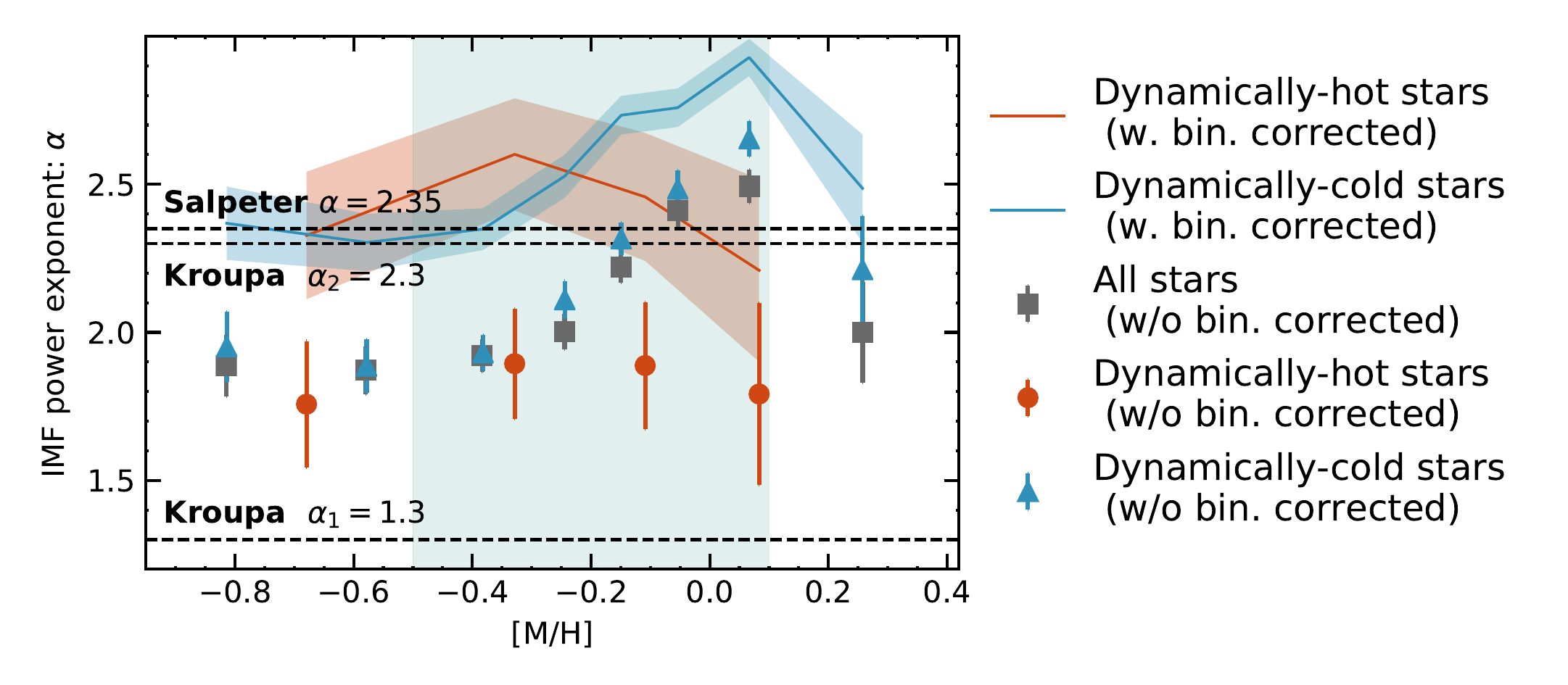
Using ~93,000 M-dwarf spectra from LAMOST, we discovered that the stellar initial mass function is not universal: early stellar populations contain fewer low-mass stars, while in present-day star formation the low-mass fraction increases with metallicity.

IMF slope variation with metallicity and age
Variations in the Milky Way's Stellar Mass Function at [Fe/H] < -1
Li, Jiadong, Rix, Hans-Walter, Ting, Yuan-Sen, Wang, Yu-Ting, Mészáros, Szabolcs, Medan, Ilija, Liu, Chao, Yan, Zhiqiang, Smith, Peter J., Qiu, Dan, Roman-Lopes, Alexandre, Green, Gregory M., Horta, Danny, Way, Zachary, Matsuno, Tadafumi, Souza, Stefano O., Fernández-Trincado, José G.
ApJL, 998, L33 (2026)
ADS | arXiv | DOI

First measurement of the stellar mass function for low-mass stars at [Fe/H] < -1 using Gaia XP spectra calibrated with SDSS-V. We find a "bottom-heavy" slope at moderate metal-poor regime and tentatively a very bottom-light IMF at the lowest metallicities.

Mass function variation with metallicity
Stellar initial mass function in the 100-pc solar neighbourhood
Wang, Yu-Ting, Liu, Chao, Li, Jiadong
MNRAS, 548 (2026)
ADS | arXiv | DOI

A new parametrization of the stellar IMF within 100 pc using Gaia DR3, accounting for observational biases and unresolved binaries. We obtain tight constraints: α₁=0.75, α₂=2.07, break at 0.40 M⊙, and ~26% binary fraction.

IMF comparison with canonical models
Millions of Main-Sequence Binary Stars from Gaia BP/RP Spectra
Li, Jiadong, Rix, Hans-Walter, Ting, Yuan-Sen, Müller-Horn, Johanna, El-Badry, Kareem, Liu, Chao, Seeburger, Rhys, Green, Gregory M., Zhang, Xiangyu
A&A, 704, A126 (2025)
ADS | arXiv | DOI

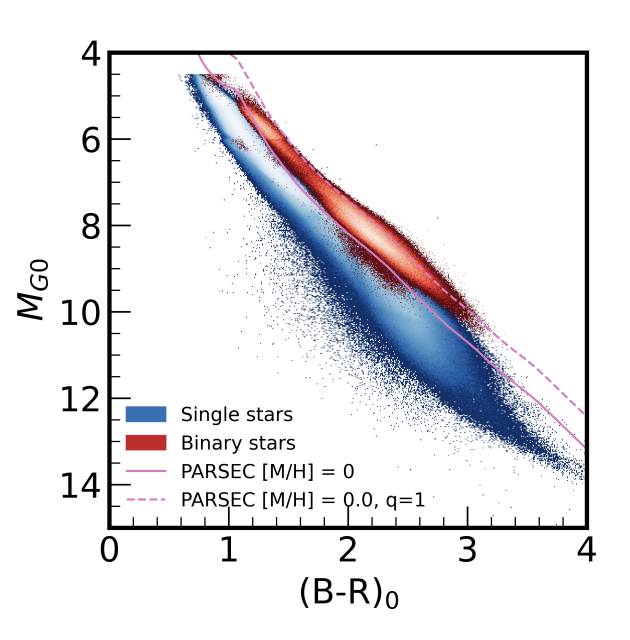
We identify 14 million main-sequence binary candidates from Gaia XP spectra using neural network forward modeling. The method detects binaries with mass ratios 0.4–1.0 and distinguishes luminous companions from dark compact objects.

CMD comparison for binary detection
Differentiable Stellar Atmospheres with Physics-Informed Neural Networks
Li, Jiadong, Jian, Mingjie, Ting, Yuan-Sen, Green, Gregory M.
ICML 2025 Workshop on ML for Astrophysics, arXiv:2507.06357 (2025)
ADS | arXiv

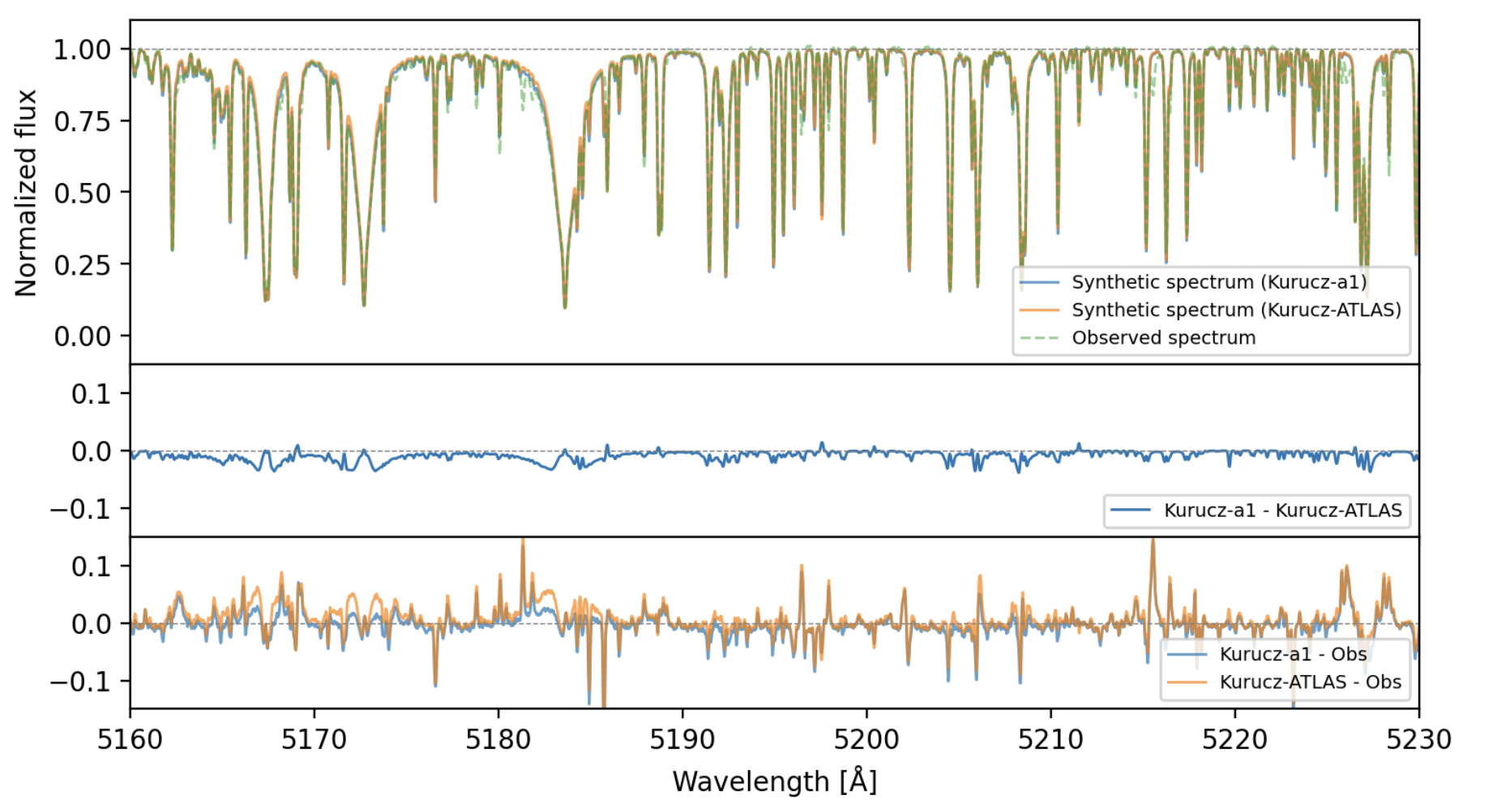
Kurucz-a1: a physics-informed neural network that emulates 1D stellar atmospheres under LTE. By incorporating hydrostatic equilibrium as a constraint, it enables differentiable stellar spectroscopy with improved physical consistency.

PINN stellar atmosphere model
Identification of 30,000 White Dwarf-Main Sequence Binary Candidates from Gaia DR3 BP/RP (XP) Low-resolution Spectra
Li, Jiadong, Ting, Yuan-Sen, Rix, Hans-Walter, Green, Gregory M., Hogg, David W., Ren, Juan-Juan, Müller-Horn, Johanna, Seeburger, Rhys
ApJS, 279, 47 (2025)
ADS | arXiv | DOI

We construct a catalog of ~30,000 white dwarf–main sequence binary candidates from Gaia XP spectra using neural network spectral modeling and Gaussian Process Classification. 70% of faint candidates show UV excess from GALEX, confirming white dwarf companions.

Color-absolute magnitude diagram of WDMS candidates
AspGap: Augmented Stellar Parameters and Abundances for 37 Million Red Giant Branch Stars from Gaia XP Low-resolution Spectra
Li, Jiadong, Wong, Kaze W. K., Hogg, David W., Rix, Hans-Walter, Chandra, Vedant
ApJS, 272, 2 (2024)
ADS | arXiv | DOI

AspGap infers stellar labels including precise [α/M] from low-resolution Gaia XP spectra by training on APOGEE data. We provide Teff, log g, [M/H], and [α/M] for 23 million giant stars, enabling Galactic archaeology at unprecedented scale.

Gaia XP spectra processing
Stellar Parameterization of LAMOST M Dwarf Stars
Li, Jiadong, Liu, Chao, Zhang, Bo, Tian, Hao, Qiu, Dan, Tian, Haijun
ApJS, 253, 45 (2021)
ADS | arXiv | DOI

We present a catalog of spectroscopic Teff and [M/H] for ~300,000 M dwarf stars from LAMOST using the Stellar Label Machine (SLAM) trained on APOGEE labels. SLAM achieves ~50 K precision in Teff and 0.12 dex in metallicity.

M dwarf HR diagram